
About Russia
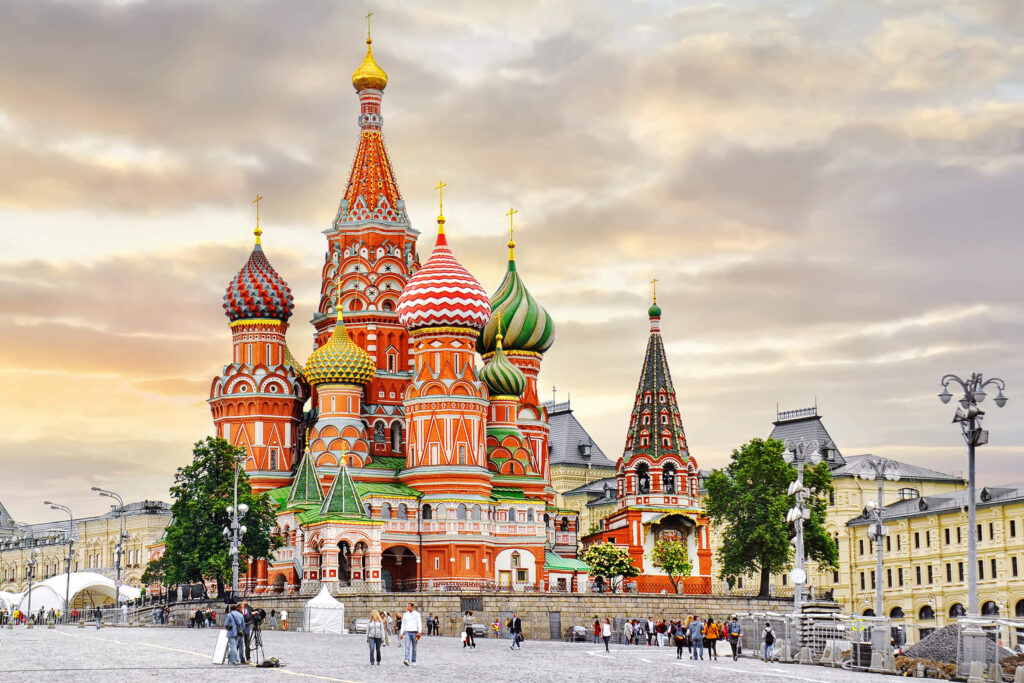
Russia, officially known as the Russian Federation, is a country with a rich historical legacy, world-famous scientists, a diverse culture, and remarkable natural beauty. Moscow serves as the capital city, and Vladimir Putin is the President of the Russian Federation.
Geography and Borders
Russia is the largest country in the world by land area, covering approximately 17,075,500 square kilometers. It surpasses Canada, China, and the United States in size. Geographically, Russia occupies much of Eastern Europe and Northern Asia, extending from the Baltic Sea in the west to the Pacific Ocean in the east, and from the Arctic Ocean in the north to the Black Sea and the Caucasus region in the south.
Moreover, Russia shares land borders with Norway, Finland, Estonia, Latvia, Belarus, Ukraine, Poland, Lithuania, Georgia, Azerbaijan, Kazakhstan, China, and North Korea. Altogether, the total length of its borders reaches approximately 58,562 kilometers, including extensive maritime boundaries.
Historical Development
The origins of the Russian state date back to 882, when leaders formed a union of cities in western Russia, with Kiev emerging as a major political and trade center. This early state, known as Kievan Rus, occupied a strategic position along the trade route between Scandinavia and Constantinople.
In 989, Prince Vladimir the First adopted Christianity, which significantly shaped Russian culture and identity. At the same time, the state expanded southward toward the Black Sea, the Caucasus Mountains, and the Volga River basin.
However, between 1237 and 1613, Mongol invasions led by Batu Khan, the grandson of Genghis Khan, devastated many Russian territories. Although invaders destroyed several major cities, Novgorod and Pskov managed to survive.
By 1480, Grand Duke Ivan the Third strengthened Moscow’s political power and successfully ended Mongol domination. As a result, he laid the foundation for a unified Russian state. Later, in 1547, his grandson Ivan the Fourth (Ivan the Terrible) became the first Tsar of Russia and expanded the state by conquering Kazan and Astrakhan.
In 1613, Russians elected Mikhail Romanov as Tsar, beginning the Romanov dynasty, which ruled for more than three centuries until the Russian Revolution of 1917. During this period, Tsars gradually centralized authority and reduced the power of the nobility.
Modern History
During the nineteenth century, Russia expanded into Central Asia, the Far East, and the Pacific coast. At the same time, large infrastructure projects most notably the Trans-Siberian Railway strengthened economic and political integration across the empire.
In 1905, Russia suffered defeat in the war with Japan, which triggered political unrest. Consequently, the government introduced reforms, including the creation of the State Duma. By 1917, revolutionary movements gained momentum, leading to the rise of the Bolsheviks, and by 1920, Soviet power firmly took control.
During World War Two, the Soviet Union endured enormous losses. Nevertheless, it played a decisive role in defeating Nazi Germany. The victory at Stalingrad marked a major turning point, and by May 1945, Soviet forces reached Berlin.
Finally, in 1990, the Russian Republic ended the Soviet era, and the Russian Federation officially declared independence.
Climate and Natural Zones
Russia experiences a highly diverse climate due to its vast territory. Most regions fall within the temperate climate zone, while northern areas lie in the Arctic and sub-Arctic zones. In contrast, a small area along the Black Sea coast of the Caucasus enjoys a subtropical climate.
Additionally, Russia includes nearly all climatic zones except tropical ones. These zones include tundra, forest tundra, taiga forests, forest steppe, and semi-desert regions. Overall, the climate remains predominantly continental, with significant temperature differences between summer and winter.
In January, average temperatures range from 0 to −5°C in western regions, whereas temperatures in Siberia can drop below −40°C. In July, average temperatures range from 1 to 25°C. Due to these climatic conditions, only about eight percent of Russia’s land area is suitable for agriculture.
Rivers, Lakes, and Forests
Russia possesses one of the largest river networks in the world, totaling nearly three million kilometers. Major rivers include the Volga, Ob, Yenisei, Lena, and Amur. Notably, the Volga River flows into the Caspian Sea and remains the most important river in European Russia.
Furthermore, Russia contains numerous lakes, both freshwater and saltwater. The largest include the Caspian Sea, Lake Baikal, Lake Ladoga, Lake Onega, and Lake Taimyr. Lake Baikal, the deepest freshwater lake in the world, reaches a depth of 1,620 meters and holds a significant share of the world’s freshwater reserves.
Forests cover approximately 40 percent of Russia’s territory. Vast coniferous forests dominate Siberia and northern European Russia, playing a crucial role in the global ecosystem.
Culture and Heritage
Russia boasts a rich cultural heritage. The country maintains over 50,000 public libraries holding more than one billion books, as well as approximately 1,500 museums dedicated to history, ethnography, art, science, music, and technology.
Meanwhile, folk culture continues to play a vital role in Russian identity. Traditional crafts, folk architecture, and decorative arts remain preserved through open-air ethnographic museums and skilled artisans working across the country.